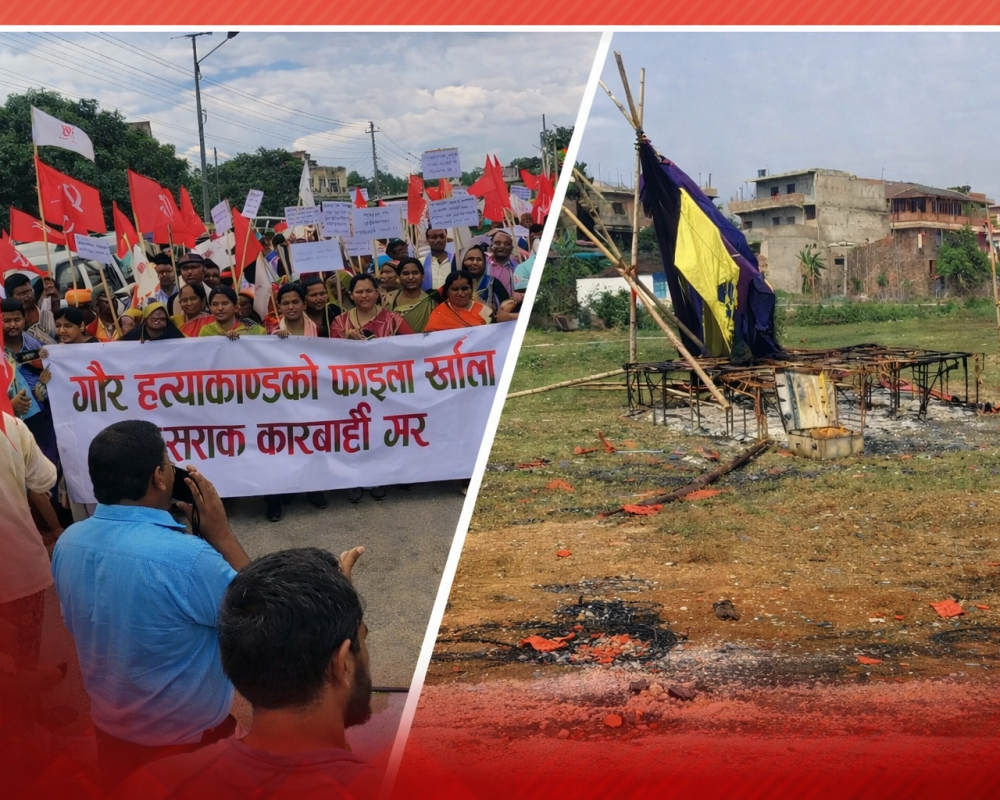
Prakash Kafle / Kathmandu – Nepal has experienced numerous movements and conflicts. The establishment of the republic itself was achieved through struggles and uprisings. However, there have been incidents so tragic that they shock the conscience even today. Even now, the victims of these violent acts have not received justice. One of the most notorious of these incidents is the Gaur Massacre. What exactly was the Gaur Massacre, and how did it happen?
Background and Nature of the Incident
On Chaitra 7, 2063 BS (March 21, 2007 AD), a violent clash occurred at the rice mill area in Gaur, Rautahat, marking one of the darkest and most tragic events in Nepalese political history. This incident is referred to as the Gaur Massacre. At that time, the Madhesi Janadhikar Forum, which was focused on Madhesi-centric politics, and the then-rebel CPN (Maoist) were engaged in a struggle for political dominance, which escalated into this horrific event.
The immediate background shows that the Forum had planned a demonstration in Parsa, Bara, and Rautahat, and Gaur’s rice mill area was chosen for the program. About a week later, the Maoists decided to hold a separate program at the same location, which heightened tensions between the two groups.
Escalation and Human Loss
Signs of a potential clash were visible two days before the event. On the day of the program, between 1,500 and 4,000 Forum supporters gathered in Gaur, armed with sticks and rods, while some Maoist activists were also present with firearms and explosives such as socket bombs. Around 1:45 PM, armed individuals attempted to disrupt the Maoist program, leading to a violent confrontation.
The clash resulted in the deaths of 28 people—27 Maoist activists were killed on the spot, and one more died during treatment. Reports also indicate that women were subjected to brutal torture during the incident.
Reason for Recent Attention
For a long time, this case was neglected due to political maneuvering and power calculations. Recently, however, it has regained public attention, largely due to the Supreme Court’s active involvement and an agreement between the government and the victims’ families. The families of the victims had been fighting a prolonged legal battle demanding justice. The Supreme Court issued directives to the government to advance the investigation and bring the perpetrators to justice. Following a five-point agreement between the Ministry of Home Affairs and the Victims’ Struggle Committee to conduct an impartial investigation, the case has once again become a focal point of national politics.
Political and Legal Impact
The case has had significant repercussions in Nepal’s political sphere. Political leaders in key positions at the time of the incident have faced increasing legal pressure. It is seen as a major step against the culture of impunity in Nepal. If the investigation reaches logical conclusions, it could set a precedent for transitional justice, ensuring accountability for crimes committed under political cover. However, the influence of political power struggles and party interests on the investigation remains a matter of concern and debate.
के हो गौर हत्याकाण्ड ? किन फेरी व्युतिँदै छ गौर हत्याकाण्डको मुद्दा