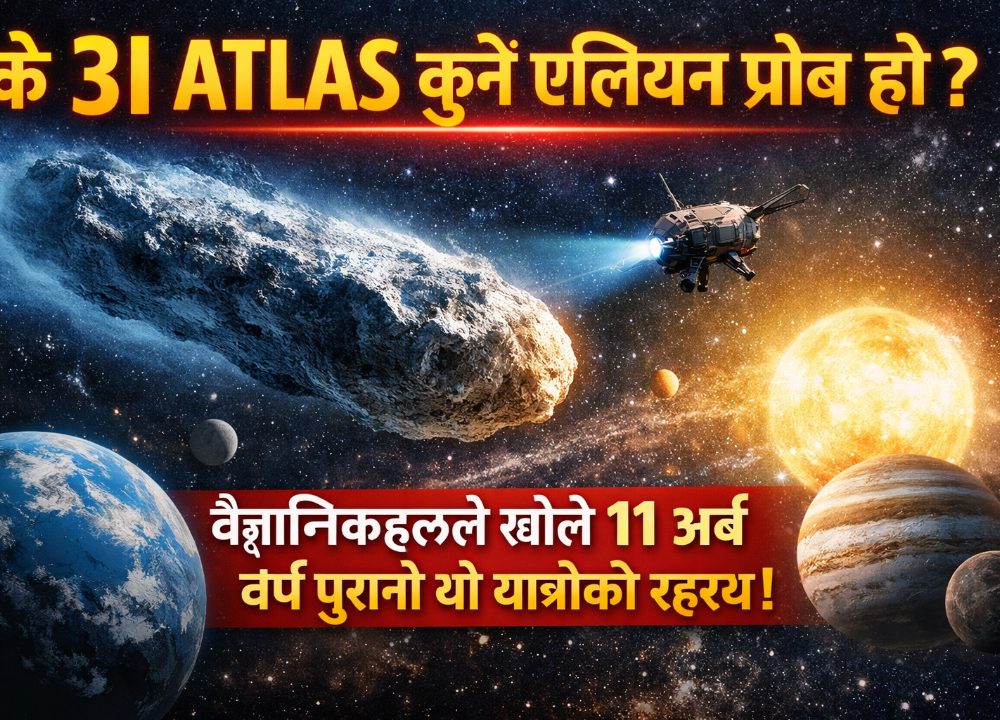
Prakash Kafle/Kathmandu – Recently, an extremely fascinating and significant event in the field of space research has been made public, generating great excitement within the scientific community. Rare objects arriving from the infinite depths of the universe have always been a subject of curiosity and study for humanity. In this context, scientists have identified a new interstellar object named “3I/ATLAS”, which is the third confirmed object of its kind to enter our solar system.
This object was discovered on July 1, 2025, using the ATLAS (Asteroid Terrestrial-impact Last Alert System) telescope system in Chile. Initially, due to its unusual brightness and exceptionally high speed, there were speculations that it might be an artificial or extraterrestrial (alien) spacecraft. Some scientists, including Professor Avi Loeb of Harvard University, highlighted this possibility because of its “peculiar” characteristics. However, recent studies—particularly data obtained from the Hubble Space Telescope and the James Webb Space Telescope (JWST)—have confirmed that it is a completely natural interstellar comet. Earlier, interstellar objects such as ʻOumuamua (2017) and 2I/Borisov (2019) were discovered. But 3I/ATLAS is considered more remarkable in terms of size, speed, and scientific importance. Initially, its size was estimated to be 10–20 kilometers, but later studies showed that its solid nucleus ranges between 440 meters and 5.6 kilometers in diameter. It is moving at approximately 58 kilometers per second (around 130,000 miles per hour), which is much faster than previous interstellar visitors. Scientific analysis suggests that this object may be 3 to 11 billion years old, indicating that it was formed in an unknown star system long before the birth of our solar system. The carbon dioxide and other gases it carries provide critical information for understanding the chemical composition of external star systems.
During its journey, 3I/ATLAS passed its closest point to the Sun (perihelion) on October 29, 2025. Later, on December 19, it reached its closest distance to Earth (about 170 million miles away), providing scientists with a rare opportunity to study it up close. As of March 2026, it is moving past Jupiter’s orbit toward the outer edges of the solar system. Its hyperbolic trajectory ensures that it will never return.
Although this object poses no direct threat to Earth, its study is expected to reveal new insights into the origin of the universe, the structure of other star systems, and the potential for life elsewhere. Since interstellar objects like this are extremely rare, the discovery of 3I/ATLAS is considered a unique opportunity to advance space science.
While no evidence of alien technology has been found, 3I/ATLAS reconfirms an important truth: our solar system is not alone, and objects from other parts of the universe can reach us. Further research and observation in the coming days are expected to provide even more detailed and profound information about this remarkable interstellar visitor.
के 3I ATLAS कुनै एलियन प्रोब हो? वैज्ञानिकहरूले खोले ११ अर्ब वर्ष पुरानो यो यात्रीको रहस्य!