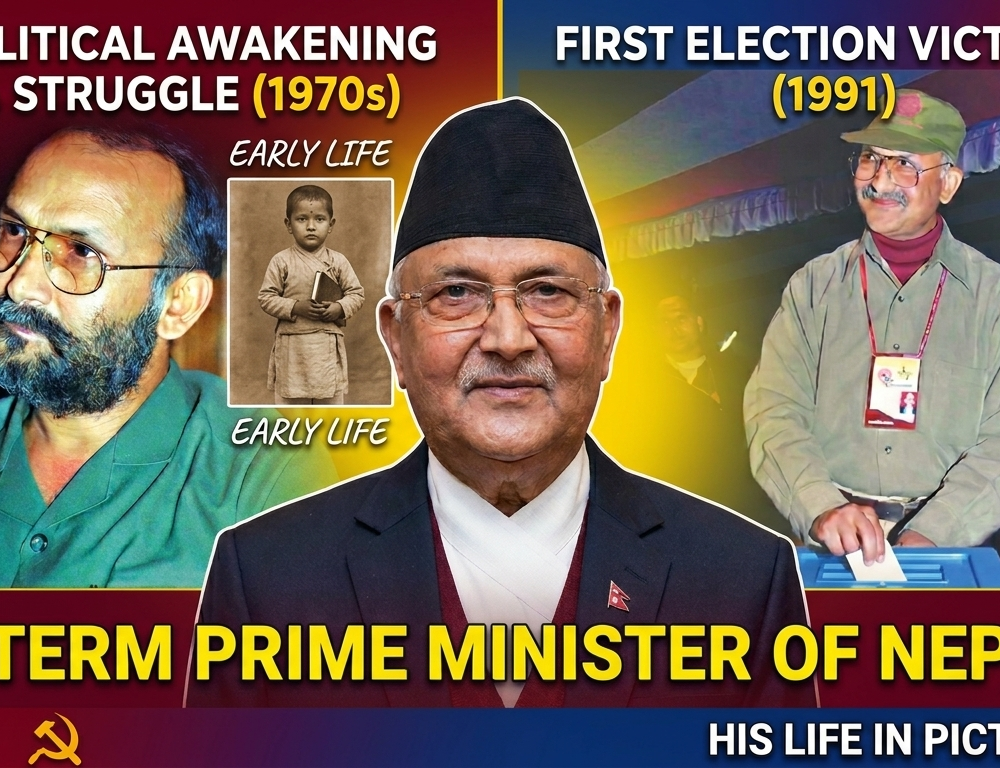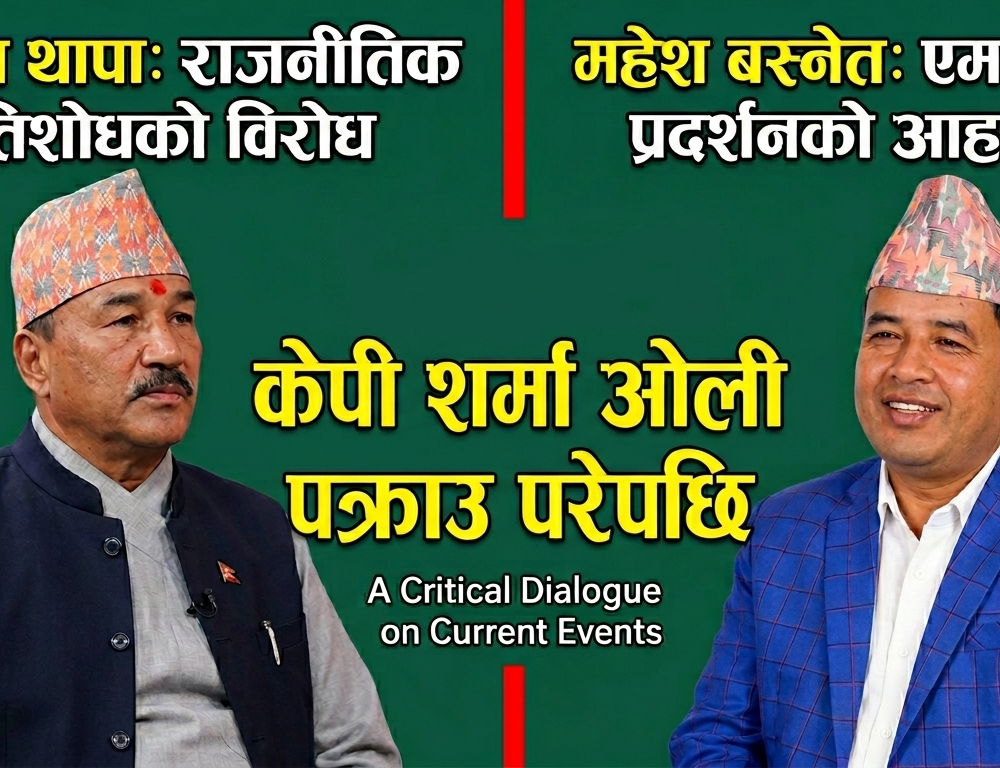
Prakash Kafle/Kathmandu. K.P. Sharma Oli is a prominent Nepali politician, communist leader, and experienced nationalist statesman. He is the chairman of the Nepal Communist Party (UML) and has also served as the Prime Minister of Nepal. Born on 23 February 1952 in a lower-middle-class family in Tehrathum district of eastern Nepal, Oli’s childhood was filled with enthusiasm and creativity. This zeal inspired him to enter political life at a young age. In February 1970, he joined the Nepal Communist Party as a full-time activist, marking the beginning of his lifelong political commitment.
His journey to leadership has been marked by personal sacrifice and struggle. Due to his political activism against the then-autocratic Panchayat system, he was repeatedly arrested on various false charges. During this period, from 1973 to 1987, he spent 14 consecutive years in prison, including four years in harsh solitary confinement (“Golghar”), which strengthened his ideological foundation. After his release, he rapidly established himself within the party as a Central Committee member of the then CPN (Marxist–Leninist) and as Lumbini Zone in-charge. He also played a key role in organizational building as the founding chairman of the party’s youth wing, the Democratic National Youth Federation (DNYF).
Following the restoration of multiparty democracy in Nepal, he was first elected as a Member of Parliament in 1991. In 1993, he became the head of the Foreign Department of CPN (UML), and in 1994, he was appointed head of the Propaganda Department. That same year, he became the Home Minister in Nepal’s first democratically elected communist government. After being elected for the third time in 1999, he also served as department head of the parliamentary party and deputy leader of the main opposition party. From 2006 to 2007, he served in the interim government as Deputy Prime Minister and Foreign Minister. His party leadership was further strengthened when he was elected chairman in 2014 at the 9th National Congress.
Oli’s leadership, forged through the Jhapa rebellion and underground struggle, is recognized for patriotism, commitment to democracy, social justice, and equality. He is seen as a leader capable of negotiating fearlessly with India even during a blockade.
Oli is established as the Nepali leader who has served the most terms as Prime Minister from the communist party, with four tenures:
- First term: 11 October 2015 – 3 August 2016
- Second term: 5 February 2018 – 13 July 2021
- Third (brief) term: Reappointed in May 2021
- Fourth term: 14/15 July 2024 – 9 September 2025
Under his leadership, Nepal’s political debate has shifted from struggles over rights to national development and economic prosperity. He is the visionary behind the national ambition of “Prosperous Nepal, Happy Nepali”. Oli has also advocated the concept of “Perfect Democracy”, guaranteeing equal rights, opportunities, social justice, security, and respect for all citizens.
During his tenure, transformative programs such as the contribution-based social security system, Prime Minister’s Agricultural Modernization Project, and Prime Minister’s Employment Program were launched. His government also took strict measures to control sexual violence against women and girls, while prioritizing climate change challenges, particularly sustainable development and environmental protection in the Himalayan region.
Opposition leaders have criticized some of these measures as vindictive, alleging that the government suppressed the Jan–G movement. The future remains uncertain regarding whether the government will arrest other accused individuals involved in incidents such as setting fire to the Singha Durbar.