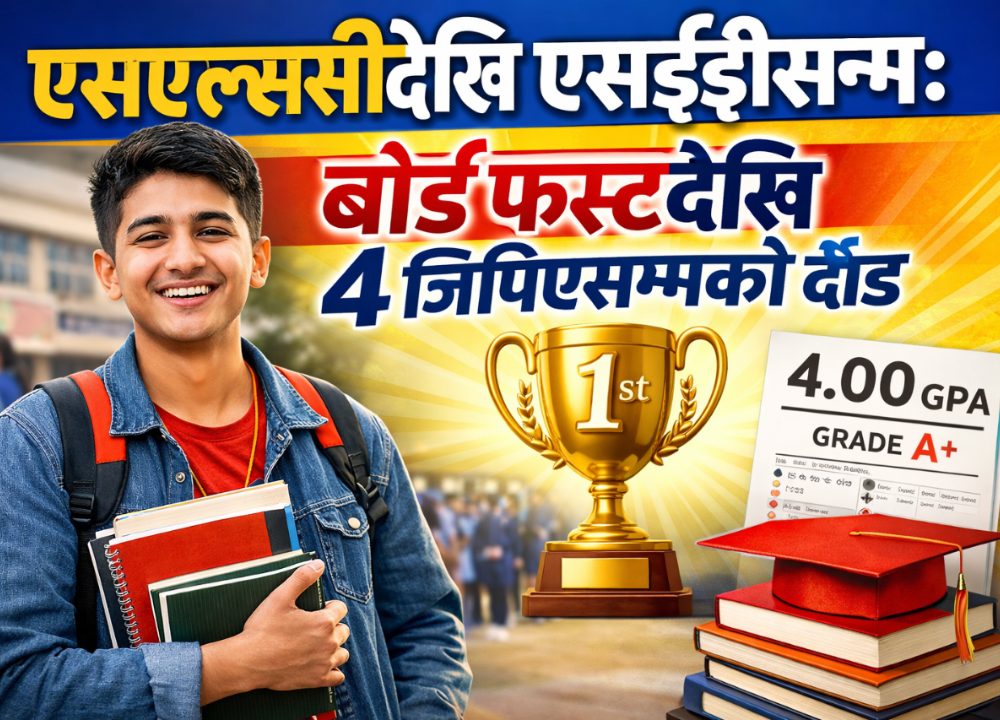
Prakash Kafle,Buddhi krishan Gautam/Kathmandu. The journey of Nepal’s education system from SLC to SEE is not just a change in name, but a story of major transformation in the evaluation system and the nature of competition. During the SLC era, securing “board first” was a matter of great prestige, where students were evaluated based on percentage and division. At that time, only a limited number of students were considered outstanding and received special recognition in society.
History of SLC in Nepal
Beginning (B.S. 1990)
The formal beginning of the SLC examination in Nepal was on Kartik 16, B.S. 1990. At that time, the “Nepal SLC Board” was established. In the first examination, a total of 34 students from across the country participated, among whom only one was a female student (Sabina Devi). The examination center was limited to Kathmandu only.
Connection with Indian Board
Before B.S. 1990, Nepali students had to go to Patna University in India to take exams. Even after the establishment of the SLC board in Nepal, Indian influence remained in affiliation and curriculum for some time. Gradually, Nepal developed its own independent curriculum and examination system.
Changes in the Examination System
Over time, many changes were introduced in the structure of SLC:
- Full Marks and Subjects: Initially, full marks varied across subjects, later standardized to 800 marks. In recent years, SEE has been conducted with 700 full marks.
- Division System: Students were classified into Distinction, First Division, Second Division, and Third Division based on marks.
Introduction of Grading System (B.S. 2072)
The biggest reform in SLC history came in B.S. 2072 when the government replaced the percentage system with a letter grading system. The main objective was to reduce the mental pressure of being labeled “fail.”
Transformation from SLC to SEE
After the eighth amendment of the Education Act in B.S. 2073, Grade 12 was considered the final level of secondary education. Accordingly, the Grade 10 final examination was renamed SEE (Secondary Education Examination). However, in common usage, people still refer to it as “SLC.”
Evaluation System in SLC
In SLC, students were evaluated as follows:
- 32%–44%: Third Division
- 45%–59%: Second Division
- 60%–79%: First Division
- 80% and above: Distinction
Students scoring below 32% were considered failed. There was also a provision for supplementary exams for those who failed in up to two subjects.
Evaluation System in SEE
With the implementation of the GPA system, achieving a 4.0 GPA has become a common goal. This has intensified competition. Both parents and students now associate high GPA with good colleges, scholarships, and a bright future. As a result, the question “What GPA did you get?” has become a measure of success.
The grading system is as follows:
- Above 90%: GPA 4.0 (A+)
- 80%–90%: GPA 3.6 (A)
- 70%–80%: GPA 3.2 (B+)
- 60%–70%: GPA 2.8 (B)
- 50%–60%: GPA 2.4 (C+)
- 40%–50%: GPA 2.0 (C)
- 35%–40%: GPA 1.6 (D)
- Below 35%: NG (Non-graded / Fail)
However, high grades alone do not define success. To succeed in life, creativity, practical skills, confidence, and ethics are equally important. Focusing only on marks can increase mental pressure and overshadow the true purpose of learning.
Effective Ways to Achieve High Marks
- Maintain regular study and proper time management
- Practice past question papers repeatedly
- Focus on understanding concepts rather than rote learning
- Maintain a healthy routine (sleep and diet)
- Manage stress and build self-confidence
Conclusion
Ultimately, education is not just a game of GPA; it is a journey of overall personality development. Therefore, both parents and students must give equal importance to knowledge and skills along with marks.