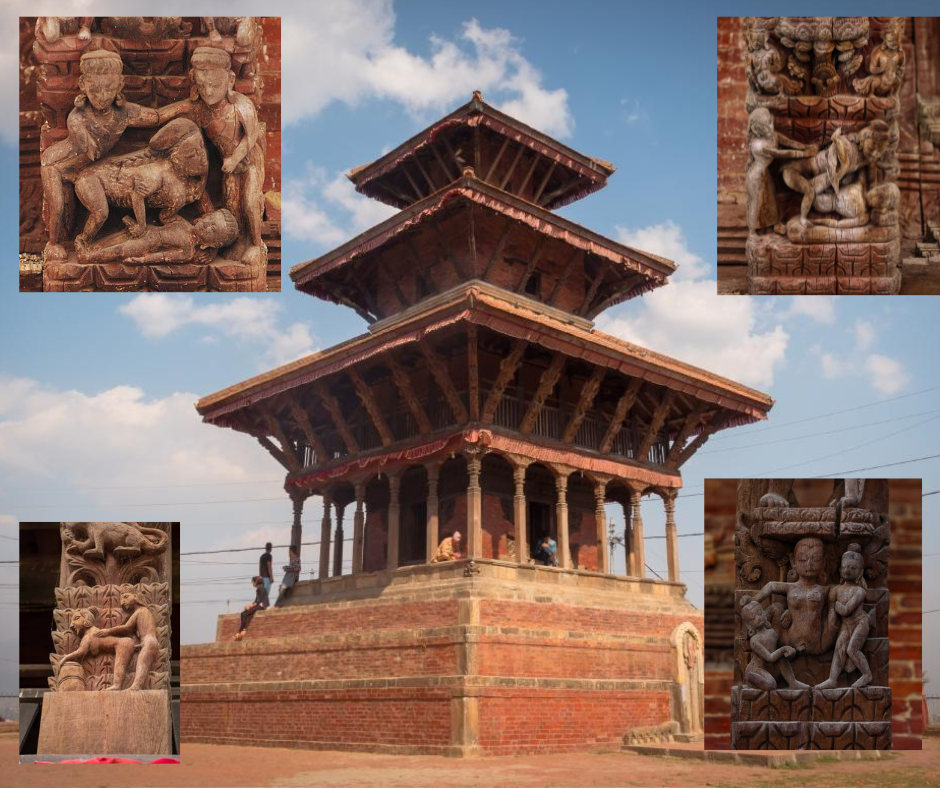
Prakash Kafle/Kathmandu. You must have at some point seen, mostly at Uma Maheshwar Temple in Kirtipur, Vishnu Devi Temple in Kirtipur, and the roofs of various other temples, scenes of sexual activities. Many historic temples in the Kathmandu Valley feature wooden carvings on the roof struts and outer sections depicting sexual activities. Although these sculptures may appear unusual to modern visitors, historians and researchers say they are closely connected to ancient religious beliefs, cultural traditions, and artistic expression.
These types of wooden sculptures are most commonly found in temples built during the rule of the Malla Dynasty, which governed the valley from the 12th to the 18th century. During this period, pagoda-style temples in the Kathmandu Valley were richly decorated with intricate wooden carvings created by skilled Newar artisans.
Religious and Cultural Reasons
According to historians, one major reason for placing erotic sculptures on temples was the belief that they could protect the temple from evil spirits or negative forces. Ancient beliefs within Hinduism and Buddhism suggested that explicit images could embarrass or distract evil spirits, preventing them from entering the sacred space.
Another explanation relates to fertility and creation. In ancient South Asian cultures, sexuality was considered a natural and sacred part of life. Therefore, placing such sculptures on temples symbolized the continuity of life and the process of creation.
The carvings are also believed to reflect the influence of Tantric tradition. In Tantric philosophy, the union of male and female energies represents cosmic balance and spiritual power. Thus, sexual union is interpreted not merely as a physical act but as a symbolic representation of divine energy and creation.
Some scholars also suggest that placing these sculptures on the outer parts of temples served as a reminder for worshippers to leave worldly desires outside before entering the sacred space.
Scientific and Sociological Perspectives
Researchers have also explored several scientific and social explanations behind these sculptures.
1. Sex Education:
In medieval times, formal education systems were limited. As a result, knowledge related to marriage, family life, and reproduction was sometimes conveyed through art and symbolic sculptures. These carvings may have served as a form of indirect public education about human relationships and reproduction.
2. Psychological Effect:
From a psychological perspective, sexual imagery naturally attracts human attention. Some scholars suggest that such images could capture people’s curiosity outside the temple, allowing them to focus more on spirituality once they entered the sacred interior.
3. Acceptance of the Natural Life Cycle:
From a biological viewpoint, reproduction is essential for the survival of all living species. Ancient societies may have incorporated this fundamental truth of life—birth, reproduction, and continuity—into religious architecture and art.
Today, these carvings can still be seen in many historic temples in Bhaktapur, Laltipur(Patan), and Kathmandu. They remain an important part of the region’s rich Newar artistic heritage and reflect the philosophical worldview of the civilization that flourished in the valley.
According to historians, these sculptures demonstrate how ancient societies viewed sexuality not as a taboo subject but as a natural and essential part of life, creation, and spirituality.
मन्दिरका छानामा किन हुन्छन् यौन दृश्यका मूर्तिहरू? – ऐतिहासिक, धार्मिक र वैज्ञानिक कारण