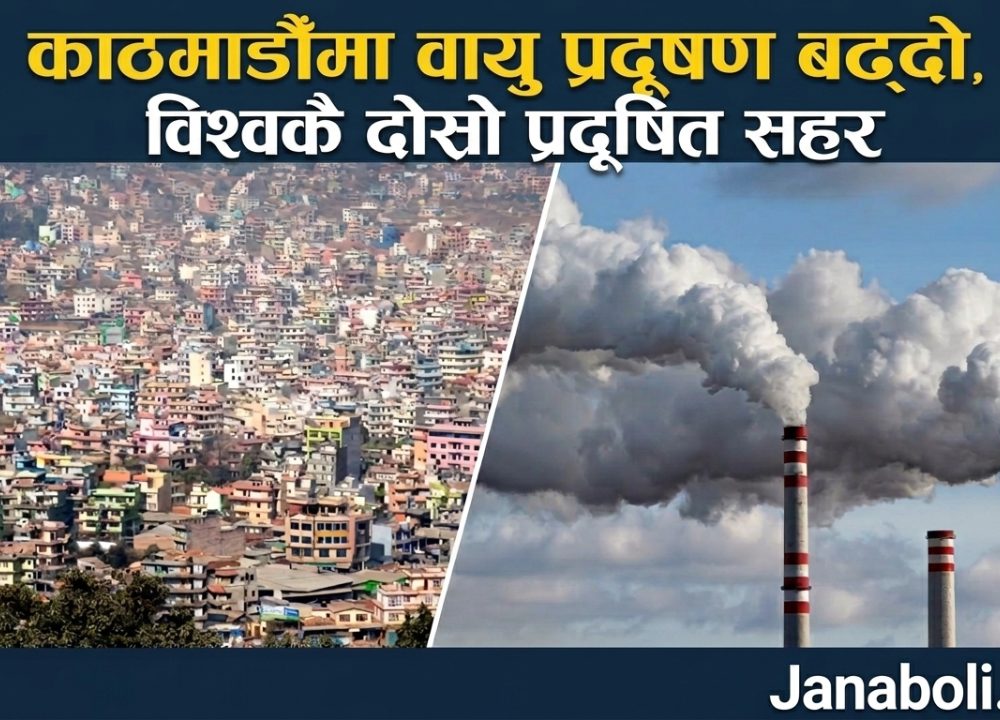
Prakash Kafle/Kathmandu. Air pollution in Kathmandu Valley has significantly increased in recent days. According to measurements taken at 1:00 PM on Tuesday, Kathmandu ranked as the second most polluted city in the world. The Air Quality Index (AQI) reached 195, which is considered “very unhealthy” for public health.
According to the Department of Environment, air quality in Kathmandu Valley has been deteriorating steadily over the past week. The atmosphere has remained hazy, and due to weak wind circulation, polluted air has not been able to disperse effectively, causing pollution levels to rise.
Within the valley, the highest pollution level was recorded in Lazimpat, where the AQI reached 226 at 1:00 PM. Similarly, the AQI in Ranibari was 196, while Kshetrapati recorded an AQI of 188. Outside the valley, Birendranagar in Mid-Western Nepal recorded the highest pollution level with an AQI of 232, while Dhangadhi in Sudurpashchim Province recorded an AQI of 209.
According to IQAir, an international air quality monitoring organization headquartered in Switzerland, Delhi, India recorded an AQI of 247, placing it among the cities with extremely unhealthy air quality. Based on the standards of the World Health Organization (WHO), these pollution levels fall into the “very unhealthy” category.
Dr. Binod Pokharel, an associate professor at the Central Department of Hydrology and Meteorology at Tribhuvan University, said that although some parts of Nepal experienced rainfall, air pollution remains high in several areas. In a social media post, he explained that weak wind movement has prevented polluted air from dispersing, while pollution from neighboring countries has also accumulated in the region.
He added that air quality is likely to improve only when stronger winds and sufficient rainfall occur. Air pollution forecasts suggest that air quality may begin to improve from Thursday, which aligns with predictions of thunderstorms and rainfall starting Wednesday afternoon.
Air pollution in Nepal usually becomes severe during the winter season. In addition to emissions from vehicles, pollution from brick kilns and industries, as well as dust and pollutants carried from India by wind currents, worsen the situation. Forest fires in different parts of Nepal also contribute to increasing air pollution levels.
According to health standards, air with PM2.5 levels below 50 micrograms per cubic meter is considered healthy. Levels between 50 and 100 indicate moderate pollution, 100 to 150 are unhealthy for sensitive groups, 150 to 200 are unhealthy for everyone, and above 200 are considered very unhealthy.
The World Health Organization recommends that the annual average PM2.5 level should not exceed 5 micrograms per cubic meter. However, Nepal’s air pollution level has been recorded at about eight and a half times higher than this standard. According to data from 2019, around 42,000 people in Nepal die every year due to diseases related to air pollution.