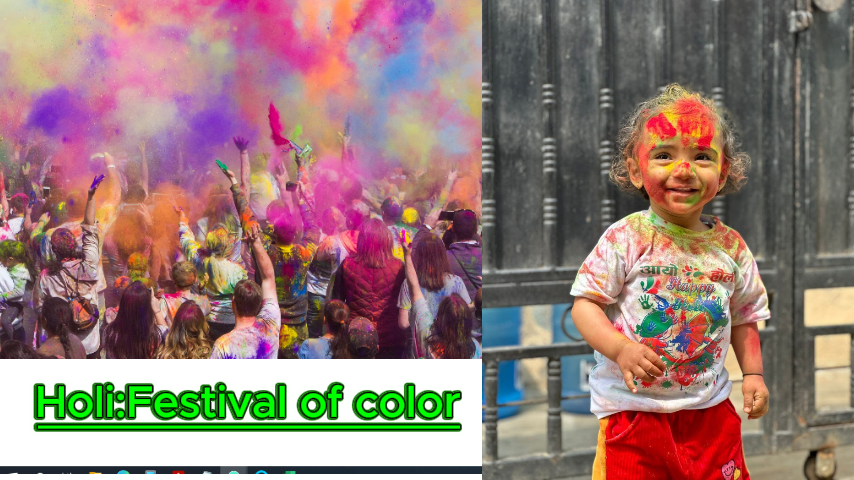
Prakash Kafle/ Kathmandu.Holi is one of the oldest and most vibrant festivals celebrated mainly in Nepal and India. It is known as the “Festival of Colors” and usually falls in the month of Falgun (February–March).
Historical and Mythological Background
- Prahlad and Holika (Victory of Good over Evil)
The most famous legend of Holi comes from Hindu mythology. King Hiranyakashyap wanted everyone to worship him, but his son Prahlad was a devotee of Lord Vishnu. The king’s sister Holika tried to burn Prahlad in fire, but due to divine protection, Prahlad survived while Holika was burned.
→ This event symbolizes the victory of good over evil.
The ritual of Holika Dahan (burning bonfire) the night before Holi comes from this story.
- Lord Krishna and Radha
In the region of Vrindavan and Mathura, Holi is connected with Lord Krishna. According to legend, Krishna playfully applied colors to Radha and other Gopis. This playful act became a tradition of throwing colors during Holi.
- Ancient References
Holi is mentioned in ancient texts like the Puranas and even in old temple carvings, showing that it has been celebrated for centuries.
Scientific Reasons Behind Holi
Though Holi is religious and cultural, it also has scientific and seasonal significance:
Seasonal Change and Health
Holi comes at the end of winter and the beginning of spring. During this time:
- The body becomes more prone to infections due to changing weather.
- In ancient times, natural colors were made from flowers like Palash (Tesu), turmeric, neem, and sandalwood.
These natural ingredients have antibacterial and medicinal properties, helping to boost immunity and protect the skin.
2. Holika Dahan (Bonfire)
The ritual bonfire has a practical explanation:
- The heat from the fire helps kill bacteria and insects in the surroundings.
- It symbolizes purification of the environment after winter.
3. Psychological Benefits
- Playing with colors reduces stress.
- Social gatherings strengthen relationships and community bonding.
- Laughing and celebrating increase the release of happy hormones like endorphins.
4. Agricultural Importance
Holi is also linked with harvest season. Farmers celebrate the good harvest of crops like wheat and barley, expressing gratitude for nature’s blessings.
Conclusion
Holi is not only a religious festival celebrating the victory of good over evil but also a festival deeply connected with nature, health, and social harmony. Its traditions reflect ancient wisdom that combined spirituality with scientific understanding of seasonal change and well-being.

