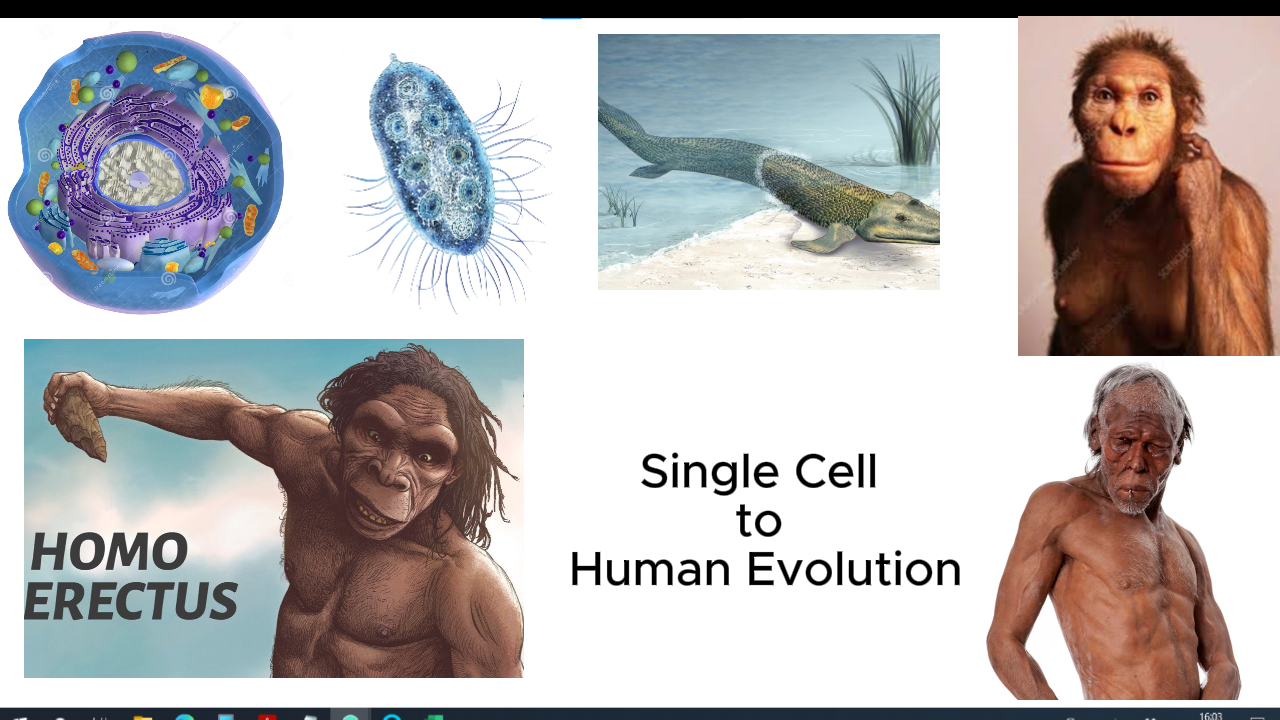
Prakash Kafle/Kathmandu. Scientists continue to uncover fascinating details about one of the biggest stories in biology: how life evolved from tiny single-celled organisms into complex beings like humans. Recent studies in genetics, microbiology, and evolutionary science are helping researchers better understand the critical steps that shaped this transformation over billions of years.
Life on Earth began around 3.5 to 4 billion years ago with microscopic single-celled organisms. These early life forms were simple, lacking a nucleus and many of the structures seen in modern cells. Over time, through gradual genetic changes and natural selection, some cells developed more complex internal structures. This transition marked the rise of eukaryotic cells — the type of cells that make up plants, animals, and humans today.
One major evolutionary leap was the development of multicellularity. Scientists have long wondered how individual cells began working together to form larger organisms. Recent laboratory experiments show that under certain environmental pressures, single-celled organisms can quickly evolve the ability to stick together and cooperate. These clusters of cells can begin specializing, with some cells taking on different roles. This division of labor is considered a key step toward complex life.
Researchers studying modern single-celled organisms that are closely related to animals have also discovered genes linked to cell communication and cooperation. Interestingly, some of these genes existed before true multicellular animals appeared. This suggests that the genetic tools required for multicellular life were already present and later adapted for more advanced forms.
Another exciting area of research involves tracing ancient genes that may date back to the earliest common ancestor of all living organisms. By comparing DNA across many species, scientists can reconstruct parts of early genomes. These studies reveal that even primitive cells had surprisingly sophisticated molecular machinery. Understanding these ancient systems helps explain how later complexity became possible.
At the human end of the evolutionary story, researchers are investigating what makes our species unique. While humans share a large percentage of DNA with other animals, small regulatory differences can have major effects. Scientists are especially interested in regions of DNA that control when and where genes turn on or off. Changes in these regulatory elements are believed to have played a major role in the development of the human brain.
Fossil discoveries also continue to fill gaps in the evolutionary timeline. From early simple life forms preserved in ancient rocks to hominin fossils showing gradual changes in posture and brain size, physical evidence supports the genetic findings. Together, fossil and molecular research create a more detailed picture of how life steadily increased in complexity.
Although many questions remain, new technologies such as advanced DNA sequencing and artificial intelligence are accelerating discoveries. Each finding adds another piece to the puzzle of how simple single cells eventually gave rise to plants, animals, and ultimately humans.
The story of evolution is not a single event but a long, ongoing process. Modern research continues to show that the journey from microscopic beginnings to intelligent life was shaped by gradual change, adaptation, and remarkable biological innovation.