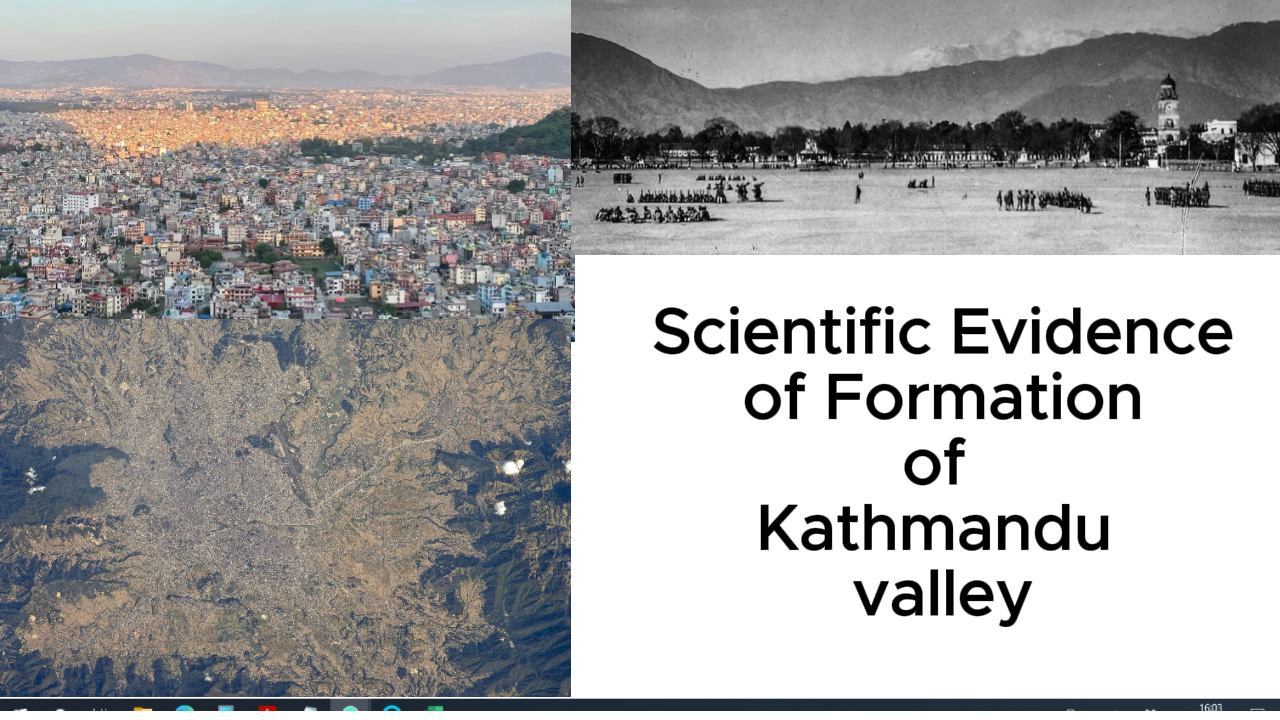
Prakash Kafle/Kathmandu. A comprehensive synthesis of geological, paleontological, and geochemical surveys of the Kathmandu Valley confirms the long-standing existence of a massive prehistoric freshwater body — the Paleo-Kathmandu Lake — supported by sediment cores, fossil records, tectonic history, and radiometric dating evidence.
Core Composition
Core drilling from sites such as Gokarna and Kirtipur revealed thick sequences of finely laminated, clay-rich sediments, typically exceeding 200 meters in thickness, consistent with lacustrine (lake) deposition:
Lower layers (80–250 m depth): Soft, dark grey to black clay with high diatomaceous content, typical of deep, quiescent lake environments.
Middle layers (30–80 m): Transitional silt and fine sand, indicating fluctuations in lake water levels.
Upper layers (0–30 m): Coarser sandy deposits with scattered gravel, indicative of fluvial action following lake drainage
Interpretation: These layers indicate that the lake gradually filled with sediment and eventually transformed into a floodplain as river activity intensified. The even layering suggests a stable lake environment with minimal climatic and hydrological fluctuations.
Fossil and Microfossil Evidence
Diatoms and Ostracods
Microscopic analysis of sediment cores revealed:
Abundant freshwater diatoms such as Cyclotella, Navicula, and Aulacoseira.
A diverse assemblage of freshwater ostracods
Palynology Findings
Aquatic plant pollen, including Typha and Potamogeton, was abundant in deep-core samples
Terrestrial pollen (grass and trees) appeared progressively in overlying layers, indicating gradual drying of the lake environment.
Interpretation: These biological traces confirm that the valley was submerged under a massive freshwater lake for thousands of years. The reduction of aquatic organisms in higher layers supports evidence of lake regression and eventual drainage.
Tectonic and Geomorphological Insights
Role of Tectonic Uplift
Kathmandu Valley occupies a tectonic basin formed by the collision of the Indian and Eurasian plates. Tectonic uplift:
Impounded paleo-river systems, forming a lake.
Created valley rims, including Phulchoki and Shivapuri Hills.
Chobhar Gorge – Natural Outlet Evidence
Geomorphological analysis of Chobhar Gorge indicates:
It acted as a natural spillway.
Lake drainage occurred via erosion and down-cutting, accelerated during periods of high rainfall or glacial melt.
Interpretation: Tectonic uplift formed a closed basin, and subsequent erosion through Chobhar Gorge enabled the release of lake water.
Climate Evidence
Sediment cores reflect past climatic variations:
Higher clay and organic content during colder, glacial periods (lower evaporation).
Sandier, oxidized upper layers during warmer interglacial periods, indicating reduced lake levels or partial desiccation
Archaeological Correlations
Archaeological surveys at Lubhu, Khokana, and Hadigaun revealed:
Ceramics, stone artifacts, and carbonized rice husks above former lake bed sediments.
Radiocarbon dating between 2,500–1,500 years
Interpretation: Human habitation in the valley only became possible after the lake had largely receded, supporting the hypothesis that the lake was a major barrier to early settlement.
Discussion and Broader Implications
Transformation from Lake to Inhabitable Valley
The Kathmandu Valley’s transformation from a freshwater lake to a habitable flood plain demonstrates the interplay between geological processes and human adaptation. The sequence of lacustrine deposition, tectonic uplift, lake drainage, and subsequent habitation highlights a unique natural-to-anthropogenic transition.
Relevance to Modern Urban Planning
Understanding the valley’s geological history informs:
Earthquake hazard planning: Old lake sediments amplify seismic waves.
Groundwater management: Sediments act as aquifers but are susceptible to depletion and contamination.
Land-use planning: Areas with deep lacustrine clay are prone to liquefaction during earthquakes.
Contribution to Himalayan Tectonic Studies
The Kathmandu Valley provides a natural archive of Himalayan tectonic and climatic change, enabling:
Reconstruction of Himalayan uplifts patterns.
Regional climate analysis over tens of thousands of years.
Insights into basin evolution in mountainous regions.
Conclusion
The Kathmandu Valley was formed through a complex interplay of geological, climatic, and hydrological processes over tens of thousands of years. Scientific studies, including sediment core drilling, fossil analysis, radiometric dating, and geomorphological mapping, provide compelling evidence for the existence of a large prehistoric lake — the Paleo-Kathmandu Lake.
Sediment cores reveal a long lacustrine history, providing scientific evidence of a stable freshwater body that existed for over 50,000 years
Microfossils, including freshwater diatoms and pollen, confirm aquatic conditions in the valley.
Tectonic activity and uplift shaped the basin, while erosion at Chobhar Gorge created a natural outlet, ultimately draining the lake.
Archaeological evidence, such as artifacts found above lake sediments, indicates human habitation began only after the lake receded, around 2,000–3,000 years ago.
The valley’s transition from a lake to a fertile floodplain illustrates the influence of tectonics, climate fluctuations, and hydrology on landscape evolution. This understanding not only illuminates Nepal’s geological past but also guides urban planning, disaster risk reduction, and sustainable development in the densely populated Kathmandu Valley.
Note:- This is the summarized form of the article published by Prakash Kafle under the Supervison of Prof.Raju Khanal during the M.Sc. Physics Program at the Central Department)